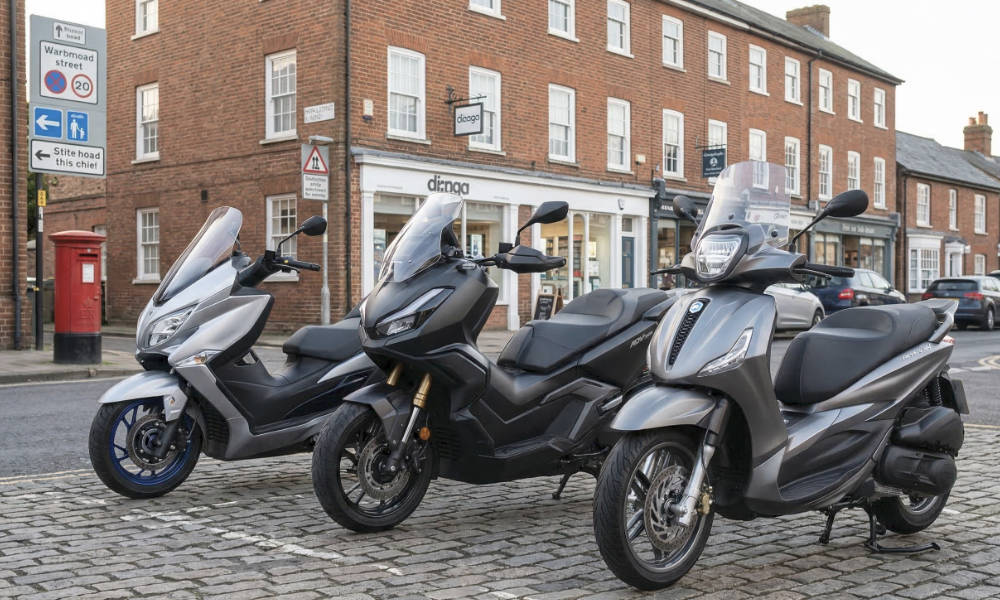
What Do We Actually Use Maxi-Scooters For? (Not What the Brochures Say!)
Take a look at the maxi-scooter market today, and you will notice it has splintered into three distinct tribes: the wanna-be adventure bikes, the heavy cruisers, and the traditional "step-thru" designs.
The manufacturers will tell you each has a highly specific, perfectly engineered use case. But let us be brutally honest; most people are buying based on image and style, not actual utility. We are buying the dream, but riding the reality. Let's break down the marketing bollox.
1. The "Wanna-be" Adventure Bikes
The Culprits: Honda ADV 350, Peugeot XP400, Aprilia SR GT
We all love the rugged, go-anywhere style of an adventure bike, and the manufacturers know it. Enter the Honda ADV 350. It looks the business with its chunky block-tread tyres, aggressive plastics, and those flashy gold inverted forks.
But let us not kid ourselves about what is actually underneath. Those forks? Yeah, they might be inverted, but they are still only a single-crown setup. Mechanically speaking, a single-crown inverted fork on a heavy scooter is arguably less suited to taking off-road hits than a standard "right-way-up" fork. And that gold anodising? That is just pure marketing to make you think of Öhlins race suspension.
Who is really taking their ADV 350 off-road? Even on a mild gravel track? I am betting it is less than 1% of owners. It is a brilliant marketing exercise, but at the end of the day, it is still a regular scooter dressed up in a North Face jacket and hiking boots to go to the supermarket.
2. The Land Yachts (Cruisers)
The Culprits: Yamaha TMAX, Suzuki Burgman 400, Kymco AK550
Okay, these do have a niche. They are low, long, and supremely comfortable. They look like spaceships and have enough under-seat storage to hide a body.
But my god, they are heavy. Whenever you read a review or talk to an owner, they always throw out the classic line: "It is actually much more nimble around town than you would expect for the weight." Let me translate that for you: "It is an absolute pig in traffic, but it is 'OK' once you get used to wrestling it." Sure, if you are eating up motorway miles by the hundred, these make sense. But again, let's be honest. If you are purely doing long motorway stints, there are much better, proper touring motorcycles out there for the job.
And people conveniently forget the drivetrain. These things are still scooters. They use CVTs, and most rely on dry centrifugal clutches. If there is one thing a dry clutch absolutely hates, it is being subjected to long, fast, high-load runs, especially in warmer climates like the Spanish summer. You are cooking that belt and clutch assembly just to look like Judge Dredd on the M1.
3. The Traditional "Step-Thru"
The Culprits: Piaggio Beverly 350/400, Honda SH350i, Vespa GTS 300
Finally, we get to the traditional scooter designs. In today's market of aggressive angles and rugged marketing, they can look a bit dated. They look like... well, scooters. They do not look particularly "sexy" or aggressive.
I know this first-hand because I own two of them, a Beverly 350 and a 400. Only the other day, someone looked at my bike and referred to it as my "moped". Yes, that stings a bit. People see the traditional step-thru shape and instantly think "50cc learner bike", completely ignoring the fact that a 400cc maxi-scooter will absolutely leave a lot of proper motorbikes for dust off the lights.
But am I going to trade it in for something with fake gold forks just to "look the part"? Not a chance.
Here is the kicker: these traditional shapes actually tick all the boxes the other two claim to own. Because they do not weigh as much as a small moon, they are genuinely brilliant around town. Because they have a proper riding position and decent engines, they are absolutely fine sitting at 70mph on the motorway. And honestly? Thanks to their lighter weight and larger front wheels (usually 16-inch on the Beverly and SH), they are no better or worse on a gravel track than the rugged ADV-style machines.
They just do not shout about it.
The Verdict
There is nothing wrong with buying a bike just because you like how it looks. If you want the gold forks or the spaceship dashboard, buy them and enjoy them. Just do not let the marketing department convince you that you have bought a Dakar rally bike or a cross-continental tourer. Underneath the plastic, it is still mostly bollox.