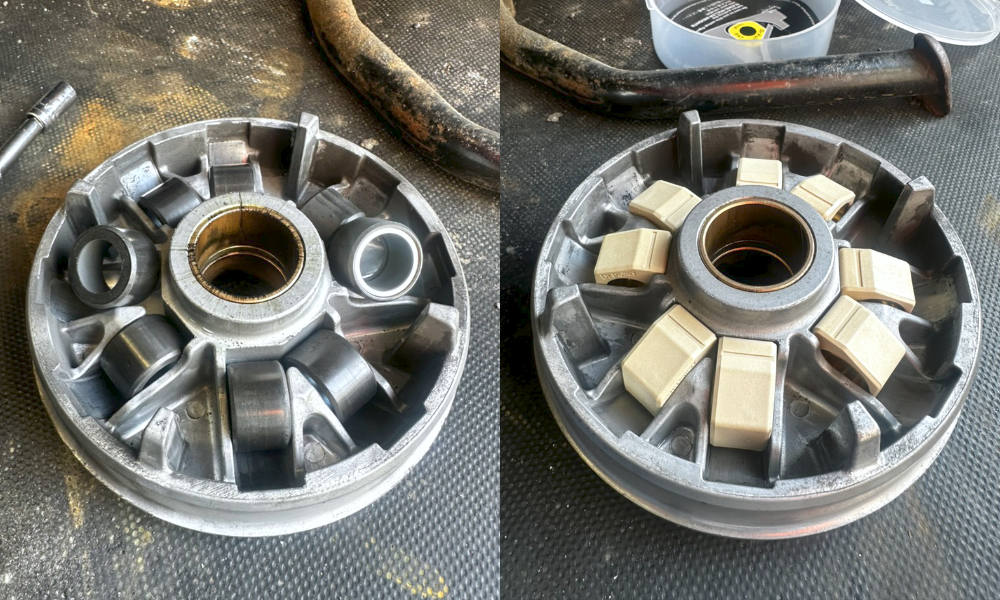
Dr. Pulley Sliders on a Beverly 350: Data vs Bollox
UPDATE: I've now put some miles on the new sliders and noticed something in the ride. It wasn't something I was looking for or focusing on, so I didn't spot it in the initial post-upgrade write-up. But it's a good one. Scroll to the bottom of the article to find out what!
First off... WTF are Dr. Pulley sliders? Unless you are into your scooter customisations, you'll be clueless about them, and that's fair enough. In a scooter CVT system, the variator (think of it as a gearbox) contains round rollers. As the engine speeds up and spins the variator, these rollers are pushed outwards by centrifugal force. This essentially changes the scooter’s gears, making it go faster. It's an incredibly clever system, but it has its weak spots, and the rollers are it. They exist inside a dirty part of the drivetrain, getting coated in belt dust and road grit, and yet they still have to roll smoothly. It’s a big ask, and often, they just don't.
Dr. Pulley sliders do things differently. They don't roll; they slide. This is a massive bonus because they don't wear as fast and are significantly less affected by dust and debris. Due to their clever shape, they also have a couple of other advantages (more on that later).
Most of the internet is full of people telling you that Dr. Pulley sliders changed their life and made their scooter faster. They'll bang on about how much quicker it is off the line and how the top speed has improved. Most of this is anecdotal bollox. I have spent enough time messing with my Beverly 350 to know that "feeling" faster and actually being better are two very different things.
In general, I'm really happy with the 350; it's my go-to when I'm back home in Northern Ireland. But one area where it falls way behind my Beverly 400 that lives in Spain is on the motorway. The 400 will cruise at 120kmph all day long with the engine merely ticking over.
The 350, on the other hand, tends to get a bit shouty once it hits about 60mph. It's only natural; it's got less power than the 400 and a lot less torque. But after reading up on it, I had a feeling that the Dr. Pulleys might help make it a bit more "400-like" for the 150-mile motorway round trip I’ll be making regularly in a few months.
Dr. Pulleys are best known for improving take-off speed, but due to their unusual shape, I figured they’d also help the top end by effectively introducing an overdrive.
Techy Bit (For Those Who Know How This Stuff Works)
Because the Dr. Pulleys have a unique wing-like shape rather than being round, they can slide further out in the variator tracks than a standard roller. This pushes the belt higher up the pulley face, effectively giving the bike a taller top gear or an "overdrive" for the motorway. It proves these bits aren't just for kids trying to wheelie; they are a legitimate tool for making a bike more capable for long-distance touring.
As most people buy Dr. Pulleys to get a punchier take-off, they usually drop the weight compared to stock to get the revs up early. I didn't. I stuck with the stock 16g weight because I wasn't looking for a boy-racer upgrade to win the lights-to-lights GP. I wanted to lower the RPMs at high speed.
And as usual, I wasn't happy to just go by "feel." I wanted data. I plugged in my OBD2 kit and went on two identical runs: one before installing the sliders, then the same run again after.
Anecdotal "Feel"
The bike didn't really feel much different off the line, but it did feel much smoother. Scooters can often "stutter" when you roll on and off the power. It's because the rollers are trying to roll up and down the variator faces and often get "hung up." Sliders slide, so the transition is much smoother. Much, MUCH smoother. It really changed the character of the 350 into a more refined machine.
Did the high-speed RPMs drop? Anecdotally, I was saying yes. Not a lot, but a bit. Sometimes it's hard to work out if a difference is real or just in your head, so it was time to pump the data from the two runs into my trusty AI tool and let it analyse the numbers.
Numbers Don't Lie
I did a baseline run with the stock 16g rollers, then swapped to the 16g sliders and did the exact same route. I held steady speeds to see exactly what the engine was doing.
Through most of the range, 0-50mph, there wasn't much of a difference. This was fine; it’s what I expected. If I’d wanted to improve off-the-line acceleration, I’d have gone with a lighter slider.
But past 50mph, things started to change, and the faster I went, the bigger the change.
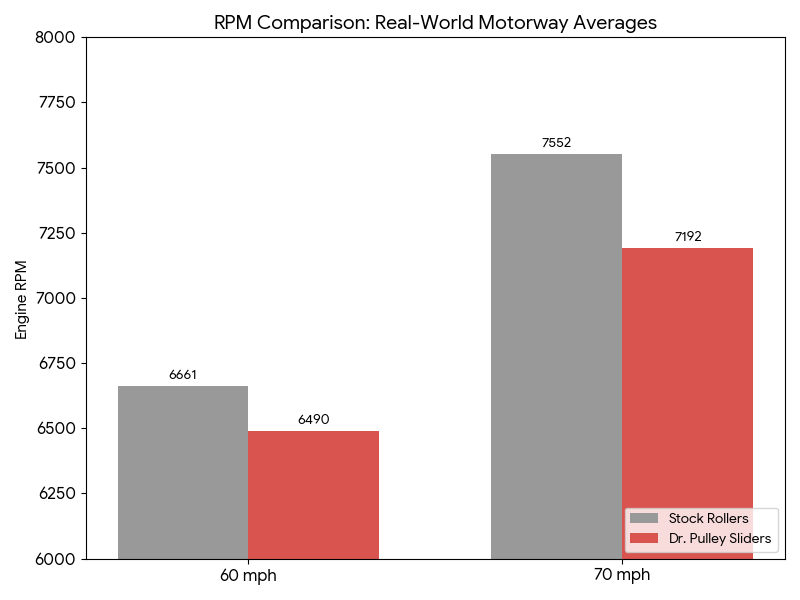
At 60 mph, the difference is minor, about 170 RPM. But once you get up to 70 mph, the sliders really start to work. The stock rollers were sitting at 7,553 RPM, whereas the Dr. Pulleys dropped that to 7,193 RPM.
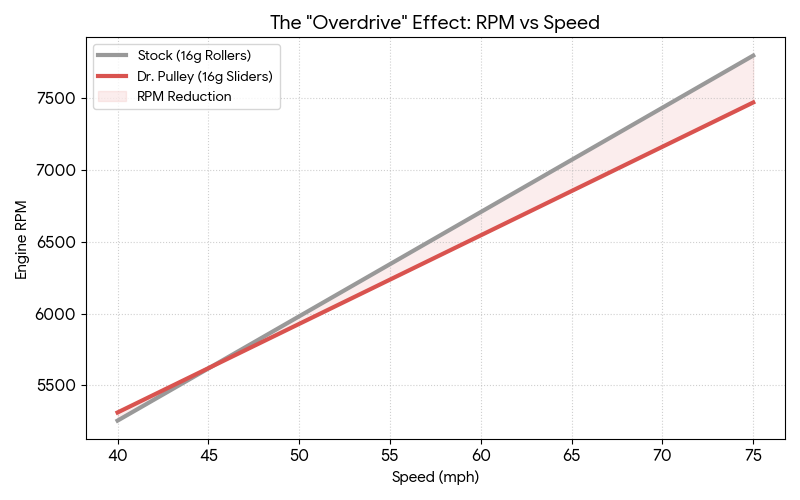
At 80mph? Well, obviously I didn't do 80, as that's illegal, but if I did, I'd have expected to see a drop around the 500rpm mark. ;-)
That is a drop of 350-500 RPM at motorway cruising speed. That's a lot! It makes a real difference to how the bike feels, how the engine wears, and I suspect, how much fuel it needs.
Why Weight Matters
By staying with the stock 16g weight, I kept the low-end delivery almost identical to the factory settings. If I had gone lighter, the bike would be screaming its head off every time I pulled away. By sticking with the same stock weight, I left the low end the same (or so I thought), but dramatically changed the top end.
The Verdict
The data proves it actually works. At 70 mph, the engine is working significantly less hard.
Beyond the numbers, the bike feels much smoother. The stutter you often get when rolling the power on and off at high speed has completely vanished.
For the price of a few pints and an hour in the garage, it is probably the best value modification you can do if you have a long commute.
Oh, and why are they called "Dr. Pulley"? Absolutely no fecking idea!
UPDATE 23/03/26
As covered above, I know that most people upgrade to Dr. Pulleys to improve off-the-line speed (by fitting a lighter weight). This wasn't my goal; I wanted to lower the RPMs at motorway speeds, in effect introducing an "overdrive." This was achieved; happy boy. :-)
So when I went out on the post-upgrade ride to log the data, I didn't really focus on the low-end speeds, but on the high end. However, having put a few miles on them, something struck me... Is the bike pulling better now at low speeds with the new sliders? It felt like it, but I'm well aware that we as humans can often convince ourselves of things we want to believe, so I went back to the numbers.
And yep. There it was in black and white (numbers don't lie, etc.). Even sticking with the stock roller weight, thanks to the weird shape of the sliders, not only have I lowered the RPM over 50mph, the sliders have also increased them below 20mph. And if you understand how a CVT works, a higher take-off RPM means more power.
Here's what’s actually happening...
From 0-20mph, the RPMs have increased by up to 150rpm. In the mid-range (20-50mph), they have stayed more or less the same as the stock rollers. Then, from 50mph plus, the RPMs have lowered (as per the original article above).
| Speed (mph) | Stock (16g Rollers) | Dr. Pulley (16g Sliders) | Difference | The Real-World Result |
|---|---|---|---|---|
| 10 mph | ~2,857 RPM | ~3,009 RPM | +152 RPM | Punchier Take-off |
| 20 mph | ~3,740 RPM | ~3,920 RPM | +180 RPM | Better Response |
| 30 mph | ~4,678 RPM | ~4,784 RPM | +106 RPM | Smooth Mid-range |
| 40 mph | ~5,420 RPM | ~5,440 RPM | +20 RPM | The Crossover Point |
| 50 mph | ~6,080 RPM | ~5,980 RPM | -100 RPM | Start of Overdrive |
| 60 mph | ~6,661 RPM | ~6,490 RPM | -171 RPM | Quieter Cruise |
| 70 mph | 7,552 RPM | 7,192 RPM | -360 RPM | Full Overdrive |
And in a pretty graph...
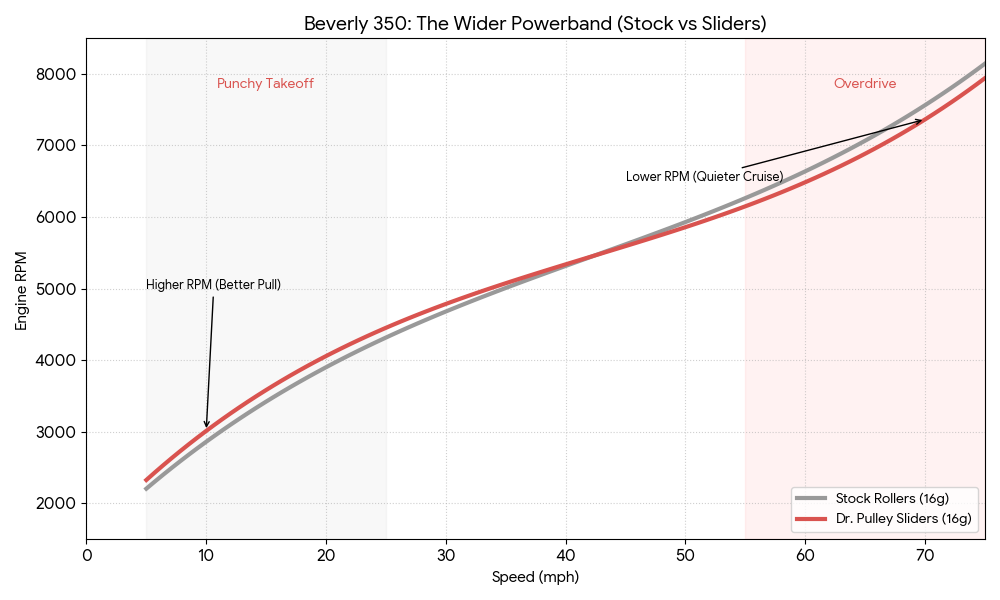
So this is pretty astonishing. Upgrading to the Dr. Pulley sliders has made some really key changes to how the Beverly 350 runs. It's achieved the "Holy Grail" of tuning: Better low-end acceleration and better top-end gearing.
If you were thinking of getting some for your own BV350; stop thinking. Do it.