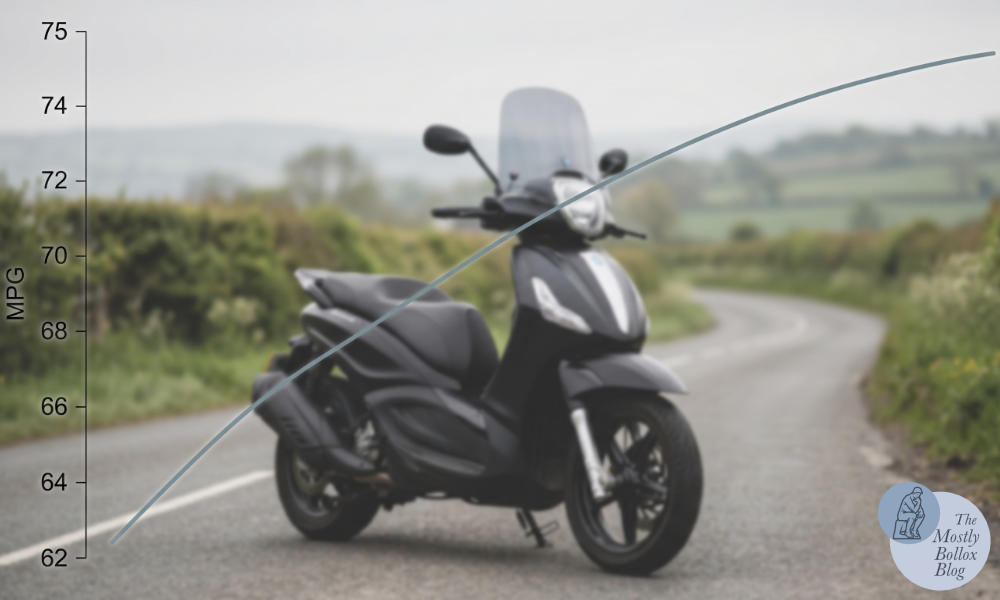
Chasing MPG: How I Got 74 MPG Out of a Piaggio Beverly 350
Chasing MPG: How I Got 74 MPG Out of a Piaggio Beverly 350
After posting a quick update in one of the Beverly Facebook groups about hitting over 74 MPG on my 350, I had quite a few people asking how I managed it.
Piaggio’s official laboratory claims for the Beverly 350 sit somewhere around the 65-70 MPG mark, and most owners on the forums report getting an average of 55-65mpg in mixed riding. So, pushing a 330cc maxi-scooter into the mid-70s without riding at a dangerously slow crawl takes a bit of explaining.
As regular readers will know, I don't really trust the "butt dyno." I prefer data. I’ve been tracking every drop of fuel that goes into this bike, along with the mechanical configurations for each tank. Over the last few months, I’ve taken the bike from a baseline of around 63 MPG up to a record 74.4 MPG.
I'\ve done this without riding it like an 80 year old, ie. I'm not pootling around at 20mph all the time. I'm not a "fast" rider; I don't go from zero to max at every opportunity. But, I'm not a slow-coach either. I'll cruise on the main roads at the road legal (sometimes above if I need to overtake), I tend to filter to the front at most stops so I usually need to get away fast, and I like to feel the wind in my hair. Bottom line: I've not got a high MPG by riding frugally.
More importantly, the bike is now significantly better to ride. It cruises at motorway speeds effortlessly, it overtakes cleanly, and the "agricultural" vibrations are gone. I was actually considering upgrading to a 400 for long-distance runs, but this process has completely killed that idea.
Here is exactly what I changed, and the data to prove it works.
Step 1: The Transmission (Dr. Pulley Sliders)
The first major change was swapping the stock variator rollers for Dr. Pulley sliders.
Most people fit Dr. Pulleys to get a faster 0-30mph time, so they drop the weight. I didn’t want a boy-racer traffic light GP machine; I wanted to drop the RPMs at motorway speeds. So, I stuck with the stock 16g weight.
Because of their unique cam shape, the sliders push the belt slightly higher up the variator face than traditional round rollers can. It essentially acts as an "overdrive" gear. My OBD2 data showed that at 70 mph, the Dr. Pulleys dropped the engine speed by about 350 to 500 RPM. That is a massive reduction in engine strain, vibration, and fuel consumption for the price of a few pints.
Step 2: Aerodynamics and the Screen
During the winter, I was running a massive "barn door" Givi screen. It kept the weather off, but it ruined the aerodynamics.
I've swapped back to a smaller custom screen now the warmer weather is here, with a crucial tweak. When I first fitted it, the screen was angled quite slack towards me, which dumped turbulent air straight onto my helmet. I was acting like a parachute. I adjusted the screen to a steeper, upright angle. Only a couple of degrees, but it's made a difference.
Counter-intuitively, this reduced drag. By punching a taller hole in the air, the wind was forced completely over my helmet in a clean slipstream. Less turbulence means less drag, which means less fuel.
Step 3: The Exhaust Curveball
I ran a Malossi exhaust for a few tanks. It breathed better at the top end, and the numbers jumped up to an impressive 72.1 MPG. But eventually, I swapped back to the heavy, quiet stock exhaust.
Why? Because of exhaust gas velocity. The stock pipe has internal baffles that maintain a specific backpressure. While the Malossi is great at the redline, the stock exhaust uses that backpressure to create a massive wave of mid-range torque. With the stock exhaust refitted, my 60-80 mph roll-on acceleration actually improved. I don't have to wring the throttle to pass a lorry; the bike just tractors past it.
The Data
Here is the complete fuel log from the autumn through to the spring. You can clearly see the progression as the weather warmed up and the mechanical tweaks were dialled in.
The Verdict
Hitting 74.4 MPG isn't magic. It is the result of getting the CVT to hold a lower RPM at cruising speed, fixing the rider aerodynamics, and retaining the factory mid-range torque.
If you are doing long motorway commutes on a 350 and finding it a bit thirsty or "shouty," sticking a set of stock-weight Dr. Pulley sliders in and tweaking your screen angle is the best money you will ever spend on the bike. No 400cc upgrade required.